
Comparison · Brother 1034D
Serger vs Coverstitch: Which Machine Do You Need?
Serger vs coverstitch: see what each machine does, why buyers mix them up and which one fits your sewing, with owner quotes, before you spend any money.
Disclosure: we may earn a commission if you buy through links on this page, at no extra cost to you. As an Amazon Associate we earn from qualifying purchases. It never changes what we recommend.
Disclosure: we may earn a commission if you buy through links on this page, at no extra cost to you.
What is the difference between a serger and a coverstitch machine? A serger finishes raw edges and sews seams with overlock stitches. A coverstitch machine makes the double-row hem you see on store-bought T-shirts. They do different jobs, and buying the wrong one is the most common serger mistake we found.
Owners say so in their own words, in reviews of the Brother 1034D. This guide helps you work out which machine you need before you spend the money. It is part of our research on the Brother 1034D serger, so we use that machine as the example.
Key takeaways
- Want clean seams and finished edges, including on knits? You want a serger.
- Want a T-shirt style double-row hem? You want a coverstitch.
- The Brother 1034D is a serger. It makes narrow and rolled hems, but not a coverstitch.
- The Singer 14T968DC is the one machine on our list that does both.
Why do people mix up a serger and a coverstitch?
A 5-star Amazon reviewer from September 2026 wrote: “Be sure to understand if you’re looking for a serger or a cover stitch machine. They do different things.” They went on to say, “I sent it back because I needed a cover stitch machine to shorten clothes.” The review is positive about the machine and still ends in a return. The machine was the wrong tool for the job they had in mind.
On r/sewing, someone asked: “Do I ‘need’ a coverstitch? Have basic sewing machine and a serger but looooove wearing knits.” That is what most people are really asking: I have a serger, I sew knits, is something missing? Another post, titled “Sergers - please explain them?”, said that despite reading about 20 online articles, the writer still did not understand them. If this feels confusing, you are in good company.
What does each machine do?
We keep this to what the Brother 1034D’s own specs and the owners tell us.
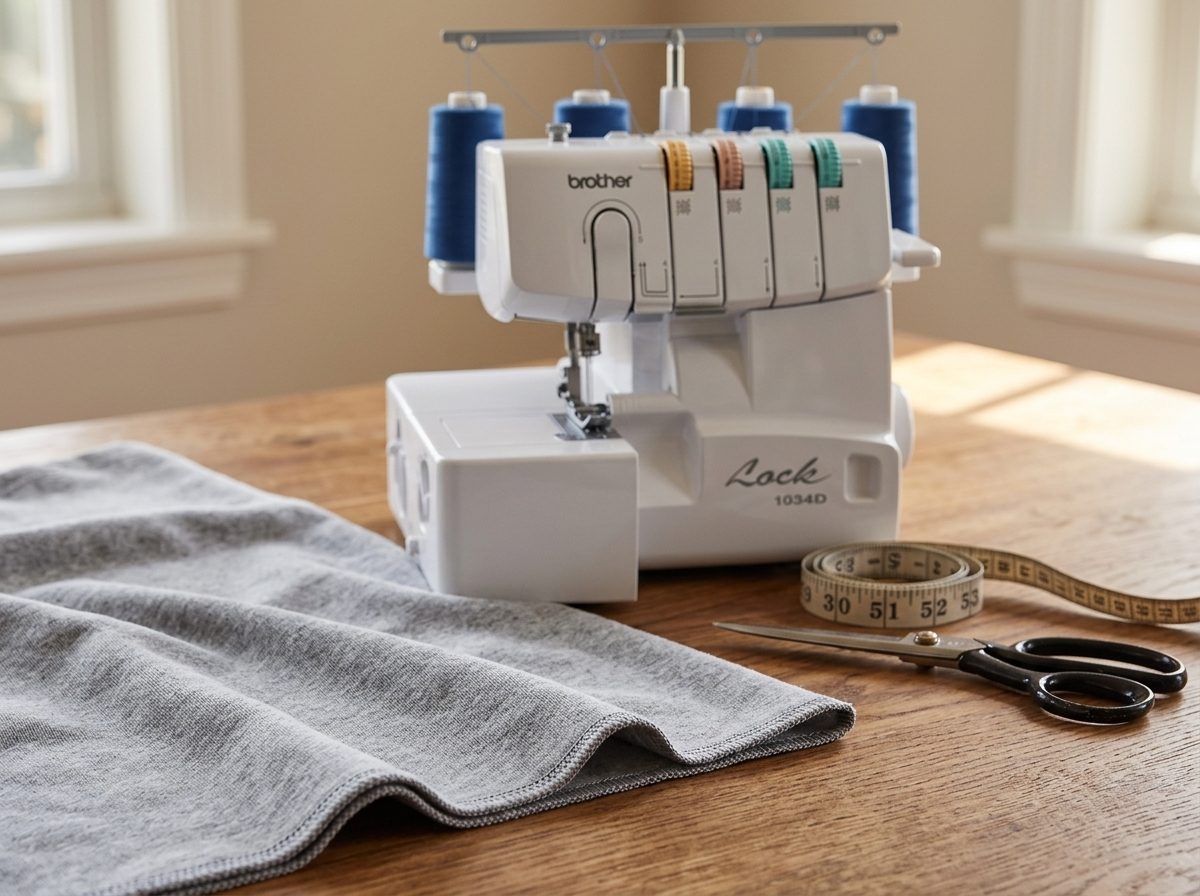
A serger (overlock machine). The 1034D makes four-thread overlock, three-thread overlock, narrow hem, rolled hem and ribbon lock. It has two needles, a lower knife and a differential feed from 0.7 to 2.0. Overlock stitches finish the edge of the fabric. The differential feed helps stretch fabric lie flat. That covers a lot of what people want: finished seams and tidy raw edges, including on knits.
A coverstitch machine. This is the machine that makes the double-row hem on store-bought T-shirts. Owners call it a cover stitch machine or a coverstitch, and they buy it to hem clothes, especially knits. The 1034D does not make a coverstitch.
Here is the trap. The 1034D does make hems, just not that hem. It has a narrow hem and a rolled hem. Those are edge hems from a serger. They are not the double-row hem on a T-shirt. If your picture of “hemming” is the look of a store-bought tee, read that again before you click.
Do you need a serger if you have a sewing machine?
They work well as a pair. Your sewing machine does the topstitching, buttonholes and zippers. The serger finishes the edges and sews seams on stretch fabric. That is why we list the 1034D as a good fit for sewists who want it alongside the sewing machine they already own.
Which one should you buy?
Ask yourself what you will sew most.
You mostly want clean seams and finished edges. This is the serger’s job. For a home sewist, the 1034D covers overlock seams, narrow hems, rolled hems and ribbon lock at 1,300 stitches per minute, according to Brother. If you sew knits, the differential feed is aimed at that. You do not need a coverstitch to enjoy a serger.
You mostly want to hem knit clothes, like T-shirts. You need a coverstitch. The 1034D is the wrong machine for this, and the reviewer who sent theirs back is the proof.
You want both, in one machine. Look at a serger with a coverstitch function. The Singer 14T968DC is the one on our list. It was rated 4.2 out of 5 from 1,503 Amazon reviews when we checked on October 27, 2026, and it sits well above the 1034D on price. It is the only machine on our shortlist that does both. We have not researched its threading or reliability as deeply as the 1034D, so read its reviews yourself before you decide.
You want both, but you already own a serger. Then the coverstitch may be the missing piece. A separate coverstitch machine could make more sense than a second serger. The Brother CV3550 comes up on Reddit as an example of a separate coverstitch machine. We have no price or rating for it in our research, so we cannot tell you more, and we do not have a tracked link for it.
When is the Brother 1034D enough?
It is enough when your list looks like this:
- You want to finish raw edges and sew seams on stretch fabric.
- You are fine with a narrow or rolled hem rather than a double-row hem.
- You sew at home, lightly to moderately.
- You want a machine with a large pool of tutorials. One Reddit sewist chose it because “everyone has” it and help on YouTube would be easier to find.
If that is you, the 1034D is a reasonable first serger. It is not a perfect one. The critical reviews are full of defects: 43 of the 100 we read mention a machine that stopped, jammed or arrived faulty, and 19 mention a looper timing problem. We cover that in the full Brother 1034D review. The fix is simple: test it the day it arrives. Our serger for beginners first-day guide shows how.
When should you look at a different serger?
You want a coverstitch hem in one machine: the Singer 14T968DC. It is a serger with coverstitch, aimed at people who sew knits and want one machine. It costs well above the 1034D and has a lower average rating on Amazon (4.2 versus 4.6), based on fewer reviews (1,503 versus 12,183). Those numbers alone are not a verdict on the machine, but they are the reason we call out the trade-off.
You sew every day for a business: a Juki. The recent critical reviews of the 1034D come mostly from heavy use or from a defect. One 3-star reviewer who sews every day for a small business said, “Keep in mind that I use my serger every single day.” For studio use, the community points to Juki or Baby Lock. The Juki MO-80CB was rated 4.8 out of 5 on Amazon. The Juki MO-654DE was rated 4.4 out of 5 from 353 reviews and sits close to the 1034D on price.
Juki MO-80CB on Amazon or Juki MO-654DE on Amazon
You want a metal body and more speed: the Brother ST4031HD. It is the heavier-duty Brother. Our October 27 search did not return it, so check that it is in stock before you plan around it.
Brother 1034D vs Singer 14T968DC side by side
| Brother 1034D | Singer 14T968DC | |
|---|---|---|
| Makes a coverstitch hem | No | Yes |
| Overlock, narrow hem, rolled hem | Yes | Not compared here |
| Amazon rating (Oct 27, 2026) | 4.6 of 5 from 12,183 reviews | 4.2 of 5 from 1,503 reviews |
| Price | See current price | See current price |
| Best for | Home sewists who need finished edges | Knit sewists who want both stitches in one machine |
We left out specs we could not verify. Where a cell says “Not compared here,” we did not confirm the detail from the maker’s page.
The honest summary
Decide on the hem first. If you want the T-shirt hem, a serger alone will not give it to you. It is better to find that out before you buy than after. If you want finished edges and seams, the 1034D does that, and its flaws are about durability and defects rather than missing features. When you are ready, our Brother 1034D serger page has the pros, the cons and the first-day plan in one place.
Frequently asked questions
Is a coverstitch the same as a serger?
No. A serger makes overlock seams, narrow hems, rolled hems and ribbon lock. A coverstitch machine makes the double-row hem you see on store-bought T-shirts.
Can the Brother 1034D hem a T-shirt?
Not with a coverstitch hem. The 1034D has a narrow hem and a rolled hem, which are edge hems from a serger, not the double-row hem on a tee.
Which machine does both a serger and a coverstitch?
On our list, the Singer 14T968DC is a serger with a coverstitch. It was rated 4.2 out of 5 from 1,503 Amazon reviews on October 27, 2026. We have not researched its reliability as deeply as the 1034D.
Do I still need my sewing machine if I buy a serger?
Yes. Your sewing machine does the topstitching, buttonholes and zippers. The serger finishes edges and sews seams on stretch fabric.
Is a serger good for knits?
Yes. The 1034D’s differential feed adjusts from 0.7 to 2.0, which helps stretch fabric feed evenly and lie flat.
Last checked: 2026-10-27. Specifications and availability checked against the manufacturer and retailer pages on this date. Prices change often, so the retailer page always wins.